Affiliate disclosure: As an Amazon Associate I earn from qualifying purchases. Purchases through these links may earn this site a commission at no additional cost to you.
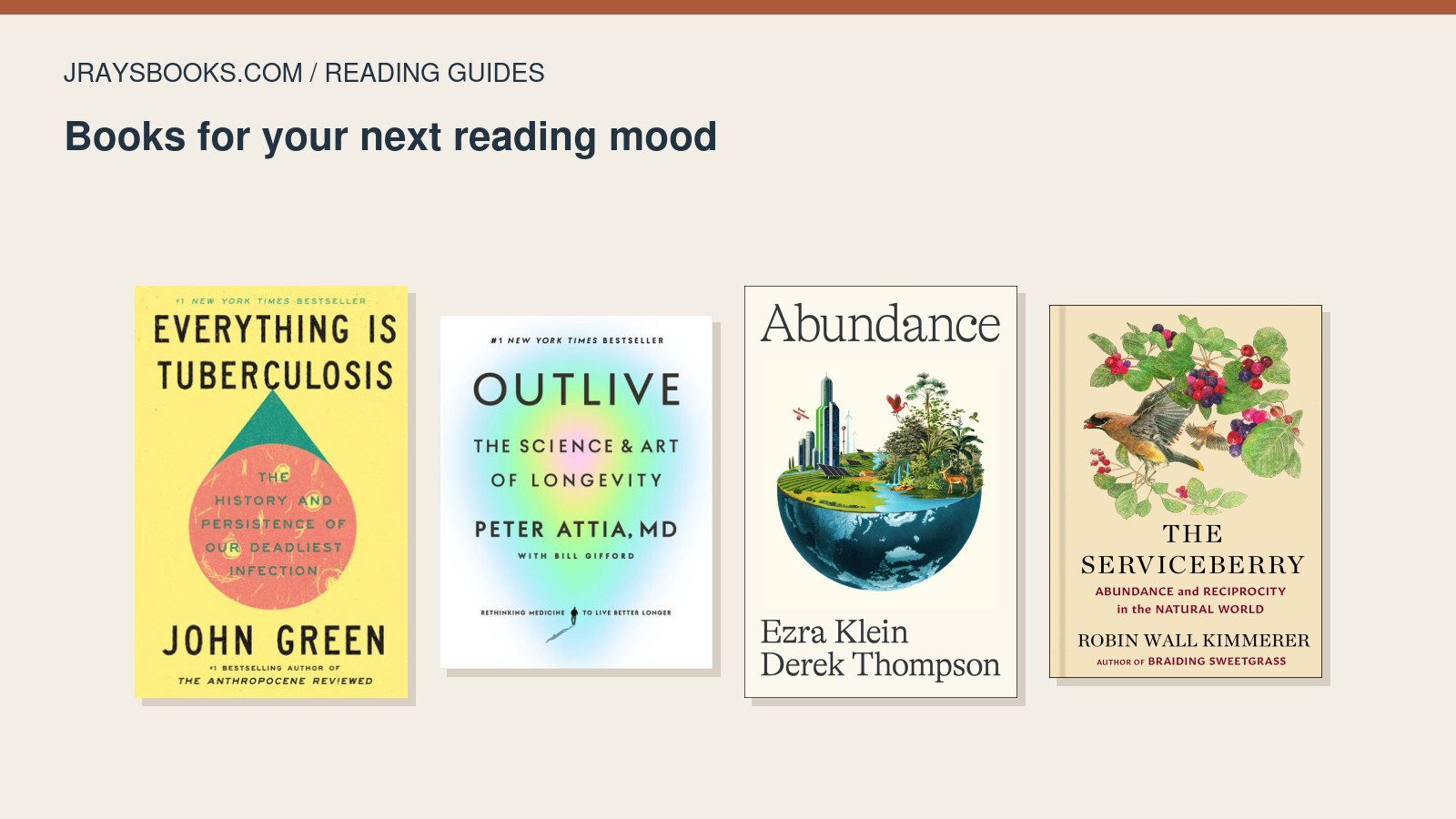
What does a better life require: earlier attention to personal health, a fairer route to medical care, more housing and infrastructure, or a different relationship with what we already have? These four books operate at different scales and do not offer interchangeable answers. Everything Is Tuberculosis looks at illness and access, Outlive at long-term individual health, Abundance at building capacity, and The Serviceberry at reciprocity. They are suggestions for thoughtful reading, not endorsements of every conclusion or substitutes for professional medical advice.
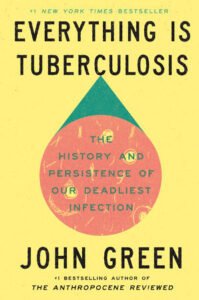
1. Everything Is Tuberculosis
John Green connects the history of tuberculosis with the experience of Henry Reider, a young patient he met in Sierra Leone. The book moves between illness, scientific history, and the inequalities that affect who receives effective care.
Why consider it?
This belongs on the list for readers who are curious about public health but do not want their only entry point to be a chart or a textbook. Beginning with a person’s experience gives a large subject a human scale without making the larger system irrelevant. The question is not only what medicine can do, but who can reach it and keep receiving it.
We would suggest it to a book club willing to examine the difference between an available treatment and an accessible one. Money, geography, institutions, and attention can all change what medical progress means in practice. It also offers a useful contrast with Outlive: one looks at improving an individual’s long-term health, while the other asks why life-saving care still fails to reach people. Read it as narrative history and advocacy, not a diagnostic manual or a source of personalized treatment instructions.
Best fit: General readers interested in medical history, global health, and the people behind debates about access to care.
Know before you pick: Serious illness, suffering, and death. This is nonfiction advocacy and history, not personal medical advice; disease statistics and treatment guidance can change after publication.
A question to take into the book: What is missing when we describe a disease as treatable without asking who can obtain treatment?
Linked edition: Hardcover · Crash Course Books · March 18, 2025 · English. ISBN 9780525556572. Confirm the selected format before ordering.
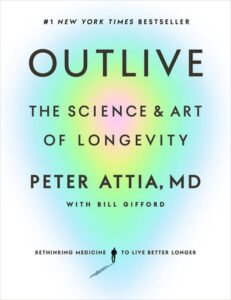
2. Outlive: The Science and Art of Longevity
Physician Peter Attia, writing with Bill Gifford, makes a case for thinking earlier about long-term health. The book discusses exercise, sleep, nutrition, chronic disease, and emotional well-being through the distinction between living longer and living well.
Why consider it?
The most useful reason to consider this book is its time horizon. It asks what you would like to remain able to do later in life, rather than treating health only as the next number on a test or the next dramatic transformation. That is an approachable starting point for readers who find the language of “optimization” less motivating than the idea of retaining ordinary abilities and meaningful relationships.
We would recommend reading it as a framework to question and discuss, not a shopping list of tests, supplements, or interventions. The strength of evidence varies between topics, and a physician’s strategy is not automatically an established clinical guideline for every reader. Personal risk, disability, age, access, and existing treatment all matter. Bring useful questions to a qualified clinician instead of assuming a broad longevity book can tell you which medical decisions are right for you.
Best fit: Readers interested in preventive health, the idea of healthspan, and a more thoughtful conversation with their clinician.
Know before you pick: Medical discussion and the author’s particular preventive-care approach. No book can guarantee longevity; do not change prescribed treatment or pursue screening/testing solely on this recommendation.
A question to take into the book: Which abilities or relationships would make extra years meaningful, rather than merely additional?
Linked edition: Hardcover · Harmony · March 28, 2023 · English. ISBN 9780593236598. Confirm the selected format before ordering.
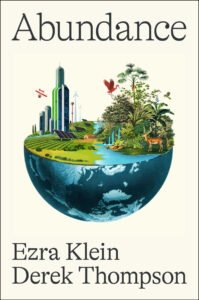
3. Abundance
Ezra Klein and Derek Thompson argue that shortages in housing, clean energy, infrastructure, and other essentials are partly shaped by political and institutional choices. They ask why ambitions to improve life so often fail to become things people can actually use.
Why consider it?
We would suggest it to someone who is tired of hearing a project announced and then watching years pass without much visible change. The authors shift attention from the attractiveness of a goal toward the ability to deliver it. That can make a discussion about institutions feel tangible: an apartment, a train line, or an energy project has consequences beyond the speech promising it.
It is an argument, not a complete manual or an agreement every economist shares. Pay attention to which barriers the authors emphasize and which trade-offs a proposed solution might create. A good reading-group question is whether building more addresses a problem by itself or must be paired with decisions about access, distribution, and harm. Choose this for a supply-focused public-policy debate, not the unrelated book of the same title by Peter H. Diamandis and Steven Kotler.
Best fit: Readers interested in housing, infrastructure, public policy, and the gap between political goals and practical delivery.
Know before you pick: A particular political/economic argument, not settled consensus or a comprehensive account of every source of scarcity. Make sure the authors are Klein and Thompson.
A question to take into the book: How should we judge a rule that protects something important while also preventing something urgently needed?
Linked edition: Hardcover · Avid Reader Press · March 18, 2025 · English. ISBN 9781668023488. Confirm the selected format before ordering.
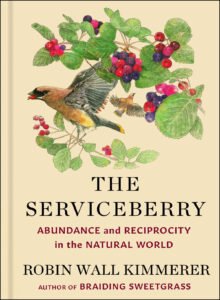
4. The Serviceberry
Robin Wall Kimmerer uses the serviceberry and its relationships with the surrounding natural community to reflect on reciprocity, gratitude, and the gift economy. The short illustrated book connects ecological observation with Indigenous knowledge and questions about what people count as wealth.
Why consider it?
This is our choice for a reader who wants a manageable nonfiction book that can still open a substantial conversation. Rather than begin with a national growth target, Kimmerer starts with relationships and the obligations created by receiving something. That offers a different scale of attention from the surrounding books: a tree, a shared harvest, a neighborhood, a habit of noticing what sustains you.
We would pair it with Abundance precisely because the two books do not mean the same thing by having enough. One emphasizes increasing what society can produce and build; the other asks how sharing, gratitude, and mutual responsibility change the meaning of prosperity. Read The Serviceberry as an invitation to examine values, not a complete economic blueprint or a claim that all Indigenous peoples share one philosophy. You can begin here without having read Braiding Sweetgrass first.
Best fit: Readers of reflective nature writing, illustrated essays, and questions about community, reciprocity, and enoughness.
Know before you pick: Philosophical and ecological reflection rather than a policy manual or foraging guide. Do not use it to identify edible plants; Kimmerer writes from a specific Indigenous and scientific perspective.
A question to take into the book: What changes when wealth is understood as the quality of relationships rather than the amount one person keeps?
Linked edition: Hardcover / paper over board · Scribner · November 19, 2024 · English; illustrations by John Burgoyne. ISBN 9781668072240. Confirm the selected format before ordering.
Book details and sources
Edition and source information reviewed October 17, 2026. No live prices, sales rankings, ratings, or availability promises are quoted.
- Everything Is Tuberculosis — edition/source details
- Outlive: The Science and Art of Longevity — edition/source details
- Abundance — edition/source details
- The Serviceberry — edition/source details
Choose books to suit your interests and content preferences. Library borrowing and reading samples are useful options before committing to a purchase or a full series.